

 Mobility & Accessibility
A practical guide to home access
How to choose a wheelchair ramp for your home
A better way in starts with the whole entrance. Understand the space, compare ramp formats and find out what the evidence means for everyday use.
Explore the entrance guide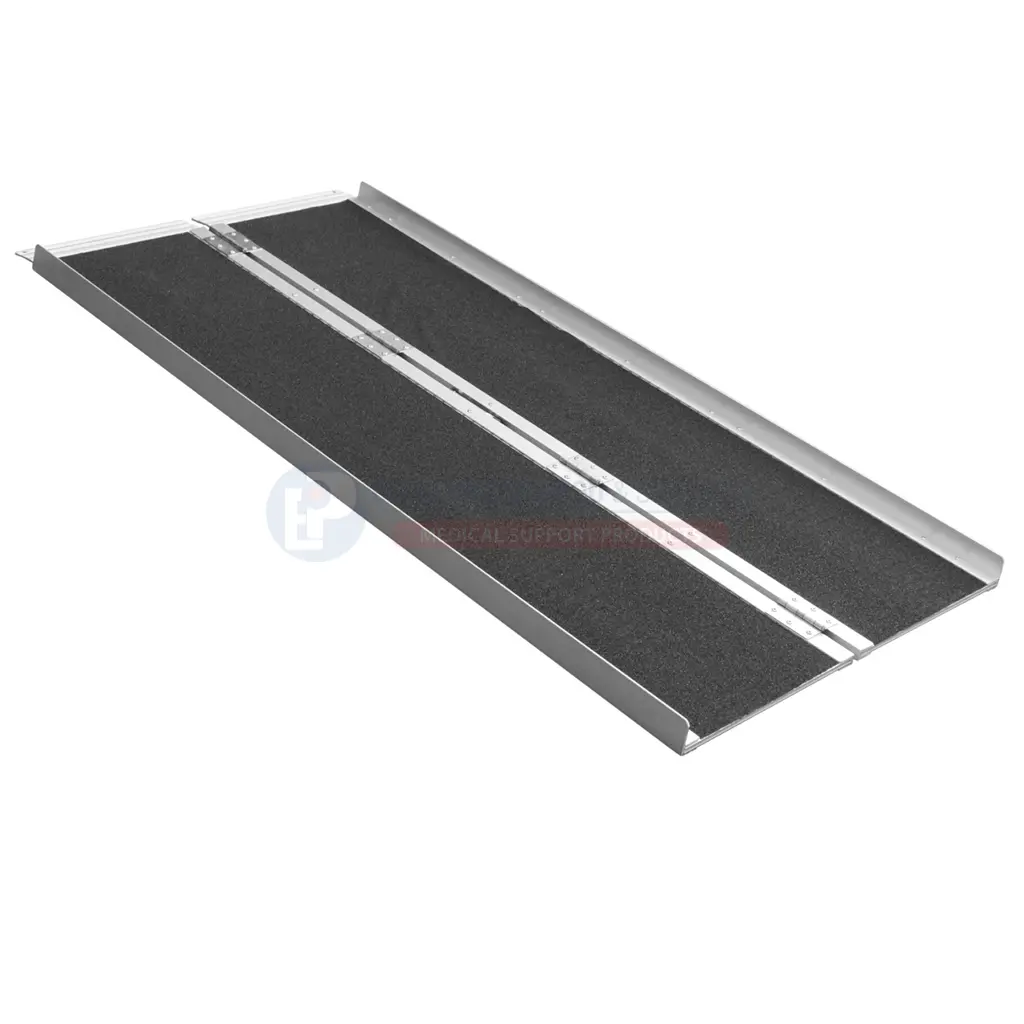
One option. A wider conversation.Match the ramp to the person, device and entrance.
Measurement concepts; no installation dimensions.
Where should you start?
Start with the person and the entrance: who will use and position the ramp, how high the entrance is, the usable doorway width and the space at each end. Then check the ramp and wheelchair instructions against those needs.
The everyday journey
Start with the person.
Follow the whole route.
Will the person push a manual wheelchair, drive a powered chair or need assistance? Consider the journey in both directions, opening the door and the routine of putting a portable ramp out and away.
The World Health Organization recommends individual assessment, fitting, training and follow-up when providing a wheelchair. That person-centred approach matters when discussing access, too. [1]
An occupational therapist or wheelchair professional can help assess individual needs. See the NHS explanation of home assessments.
Look at the complete entrance
Three measurements.
One connected space.
The step height is only the beginning. Include the doorway, the surface before the ramp and the space to stop and manoeuvre at the top.
- Total riseThe vertical height from the ground to the entrance. For several steps, record their combined rise. Note any separate change in level inside the doorway.
- Clear openingThe usable doorway width with the door open. Check that the wheelchair can pass without catching the frame.
- Approach & turning spaceThe room to approach, turn and stop at both ends. Include the door swing, obstacles and any sideways tilt in the ground.
These diagrams show what to measure, not a specified ramp installation.
Look at the ground
Note loose surfaces, uneven support points, water exposure and changes in level along the route. Confirm the permitted conditions for the exact product.
Look beyond the slope
A ramp needs an appropriate transition at each end. Door movement and room to manoeuvre are part of the access problem.
Measurement prompts: Enable Access site assessment. See also the US Access Board’s illustrated ramp guide; source notes explain its US scope.
Know the differences
Four common
wheelchair ramp types.
Use these four formats to understand the main differences before comparing specific products.
Threshold
For a small doorway transition. Check the profile on both sides, the support surface and whether the door can still operate.
Full-width folding
A platform that folds for storage. Compare its length when opened, usable width, carrying weight and the support needed at each end.
Telescopic tracks
Two separate tracks that extend to adjust their length. All wheels must align with their paths. Check tyre width and ground clearance; do not assume scooter or rollator compatibility.
Modular system
Sections joined together to create a planned access route. Larger changes in height may need level platforms, a different route or another access solution.
Sources: manufacturer’s ramp-format guide and channel-ramp considerations. Threshold and modular formats are included for general knowledge; ask about current supply.
What the research tells us
Incline changes the effort.
The person changes the answer.
The practical takeaway: consider how steep the route is, whether the ground tilts sideways and how the person will move the wheelchair. The research below explains why effort and control belong in the decision.
A 2022 review of the research
Rouvier and colleagues brought together research on pushing manual wheelchairs over slopes, sideways slopes, curbs and different surfaces. The studies used different methods, making direct comparisons difficult.
The review searched published research through May 2021.
Read the systematic reviewSteeper inclines demanded more.
In a study of 18 experienced manual-wheelchair users with spinal cord injury, forces applied to the wheel rims generally increased as the treadmill became steeper. Not everyone completed the steeper conditions.
Small, mostly male sample; speed was held constant for each person across slopes. Read the study.
Sideways tilt matters, too.
In a study of nine manual-wheelchair users, participants responded differently to the downhill turning tendency on a surface that tilted sideways—a cross-slope.
Small, exploratory study; it does not establish a technique suitable for every user. Read the study abstract.
Why length alone cannot decide.
A longer ramp reduces the incline for the same rise but needs more space. It still has to work with the approach, doorway and wheelchair.
Check both equipment manuals. Cardiff and Vale’s wheelchair guidance warns against exceeding the wheelchair’s slope limit. [5]
Explore the range
Two options.
Two different practical questions.
We’ve explained four common ramp formats. Here are two options from our catalogue to discuss with our team.
152 cm folding wheelchair ramp
A full-width suitcase format with a carry handle and an anti-slip running surface.
Discuss the handling: who will carry and position it, and does the deployed ramp fit the route?
View the folding ramp
Telescopic wheelchair ramps
Two separate tracks with adjustable length. The instructions state that this model must not be permanently installed.
Discuss the wheel layout: do all wheels follow the tracks, with the required clearance and support?
View the telescopic rampsSpecifications: manufacturer’s model-family instructions, September 2024, page 2. Check the instructions supplied with the actual unit. Ask our team to confirm the supplied configuration and availability.
Before you choose
Keep the everyday details
in the decision.
- Inspect before useCheck for damage and wear, the required fasteners and the support points. Do not use a damaged ramp.
- Check the complete loadInclude the wheelchair, person and any other load required by the proposed use. Follow the exact model’s limit.
- Confirm the environmentCheck the permitted surface and weather conditions. An anti-slip finish is not a guarantee against slipping.
- Plan assistanceAsk for individual guidance if you are unsure about control, assistance or positioning.
Use the ramp’s instructions, the wheelchair manual and appropriate professional guidance. Assessing the end user includes the mobility device, combined load and daily routine.
Can I choose a ramp by the number of steps?
Record the total rise, step depth and available route. Two entrances with the same number of steps may need different solutions. See the site-assessment guidance.
Does a portable ramp mean independent access?
Not necessarily. The person also needs a practical way to deploy it and manage the full journey. Discuss abilities, assistance and the equipment together; the WHO guidance supports an individual assessment process.
Which ramp slope should I use for a home in Cyprus?
The appropriate slope depends on the entrance, equipment instructions and the person using it. For a permanent route, ask a qualified designer or relevant authority to check current Cyprus requirements. OPAK’s accessibility resource links local regulations and amendments.
Your entrance. Your next step.
Bring us the details.
Let’s explore the options.
Tell Prodromou Medical what you need to access and which wheelchair or mobility device you use.
Ask about a ramp for your homeA useful enquiry includes
- The doorway or steps you want to access.
- The total rise and available space, if known.
- Your mobility device and who will use or handle the ramp.
The button opens our contact form so you can share these details with our team.
Sources & further reading
Research on wheelchair movement helps explain effort and control. Product specifications come from manufacturer documentation.
- WHO wheelchair provision guidelines, 2023. Assessment, fitting, training and follow-up.
- Rouvier et al., systematic review, PLOS ONE, 2022. 34 studies of manual-wheelchair movement; methods and populations varied.
- Gagnon et al., incline study, JRRD, 2014. Laboratory propulsion; 18 experienced participants with spinal cord injury.
- Assila et al., cross-slope study, Clinical Biomechanics, 2024. Exploratory study of nine users; abstract reviewed.
- Cardiff and Vale wheelchair safety guide, printed pages 6 and 12. No publication date identified.
- NHS home adaptations, reviewed December 2025. UK service and funding details excluded.
- Manufacturer’s ramp-family instructions, September 2024. Exact model information; check the supplied unit.
- Enable Access: the site and the person, 2017. Commercial technical guidance, not a clinical trial.
- US Access Board: ramps. Useful design concepts; US requirements are not Cyprus requirements.
- OPAK accessibility resources. Cyprus regulations and dated amendments; site-specific applicability needs confirmation.