

High blood pressure often has no noticeable symptoms. A careful home record can give your healthcare professional useful information beyond a single appointment—and a consistent measurement routine makes that record more useful. NHS: high blood pressure · American Heart Association: home monitoring
This guide explains how to prepare, position the cuff and record your readings, then looks at the evidence and practical features behind the Braun monitors available from Prodromou Medical in Cyprus.
Why measure your blood pressure at home?
Feeling well does not reliably tell you whether your blood pressure is high. Over time, untreated high blood pressure can increase the risk of problems including heart attack, stroke and kidney disease. Measuring it is a practical way to identify a concern that may otherwise go unnoticed. NHS: high blood pressure
Home monitoring can help a clinician assess suspected high blood pressure or review how treatment is working. It complements appointments; it does not replace them. Keep taking prescribed medicines unless your healthcare professional tells you to change them. American Heart Association: home monitoring
A reliable routine, step by step
1. Check the monitor and cuff first
Choose a validated upper-arm monitor with a cuff that fits your arm circumference. Measure around your upper arm and compare that measurement with the cuff’s printed range. Take the monitor to an appointment so a healthcare professional can check your technique and compare its readings with their equipment. American Heart Association: home monitoring
2. Prepare before you sit down
Avoid smoking, caffeine and exercise for at least 30 minutes beforehand, and empty your bladder. Choose a quiet room, then rest for at least five minutes before measuring. Make this a repeatable routine at similar times each day. Braun: how to use your monitor · American Heart Association: home monitoring
3. Support your body and arm
Sit on a chair with your back supported, feet flat on the floor and legs uncrossed. Rest your arm on a table or suitable support, with the middle of the cuff at heart level. Keep the arm relaxed; holding it up yourself is not the same as supporting it. ESH: blood-pressure measurement
4. Fit the cuff on bare skin
Follow your monitor’s cuff diagram. Braun’s general guide places the cuff about 2–3 cm above the elbow, snug but comfortable, with the tube unpinched. Avoid a tight rolled-up sleeve. Ask your clinician which arm to use, then use that arm consistently. Braun: how to use your monitor · NICE NG136: measurement and home records
5. Stay still, then repeat
Start the measurement and remain quiet and still. Do not talk, text or watch something distracting. For a standard home record, take two readings at least one minute apart. Braun’s general guide advises about three minutes between readings; follow the interval in your own manual or your clinician’s plan. Braun: how to use your monitor · NICE NG136: measurement and home records
6. Keep both results
Record the date, time, systolic and diastolic readings, and pulse if shown. Save both readings rather than choosing the lower one. If the monitor has separate user memories, check the selected user before starting so records stay distinct.
| Common mistake | A better setup |
|---|---|
| Measuring straight after activity | Allow the preparation interval, then sit quietly before starting. |
| Arm resting too low | Adjust the support so the cuff is at heart level. |
| Cuff over clothing | Place the correctly sized cuff directly on the upper arm. |
| Talking or moving | Keep quiet and still during the reading and the rest between readings. |
| Recording only a preferred result | Keep the complete record for your healthcare professional. |
The preparation and positioning checks above follow ESH’s measurement guidance and Braun’s instructions. ESH: blood-pressure measurement · Braun: how to use your monitor
How often should you measure—and what do the numbers mean?
Agree the schedule with your healthcare professional. When home monitoring is used to help confirm a diagnosis, NICE recommends two readings per session, morning and evening, for at least four days and ideally seven. The first day is excluded when calculating that diagnostic average. Keep every reading so your clinician can interpret the complete record. Ongoing monitoring may use a different schedule. NICE NG136: measurement and home records
- SYS · systolic
- Pressure when the heart contracts and pumps.
- DIA · diastolic
- Pressure between heartbeats.
- mmHg
- The unit used for the blood-pressure values.
The pulse figure is your heart rate, a separate measurement. Braun: what is blood pressure? · Braun ExactFit 2 specifications
A series of readings is more informative than one isolated result. Ask your clinician what range and follow-up plan apply to you. A monitor’s colour indicator is a quick reference, not a diagnosis or a personal treatment target.
What is the evidence behind Braun’s accuracy?
For a blood-pressure monitor, clinical validation is more useful than a broad promise of accuracy. The evidence should identify the exact model, cuff range, population and testing protocol.
A PUBLISHED STUDY · BRAUN BUA4000
Tested against the AAMI/ESH/ISO Universal Standard
A study published online in November 2023 and in the April 2024 issue of Blood Pressure Monitoring found that the Braun BUA4000 met both validation criteria of ISO 81060-2:2018 and its 2020 amendment in the studied general population.
The average device-minus-reference difference was +0.9 mmHg systolic and −0.3 mmHg diastolic, with a standard deviation of 6.4 mmHg for each. These are group results; they do not promise that every personal reading will be within 0.9 mmHg of a reference. Published BUA4000 validation study
ExactFit 1E (BUA4000): STRIDE BP lists this model for adult home use with a validated 22–42 cm upper-arm cuff. ExactFit 2 (BUA4050): STRIDE BP lists it as equivalent to the BUA4000, based on evidence accepted by its Scientific Advisory Board. That is an equivalence listing, rather than a claim that the BUA4050 was the device tested in that particular study. STRIDE BP: Braun BUA4000 · STRIDE BP: Braun BUA4050
What “ESH” means here: the European Society of Hypertension contributes to measurement and validation standards. ESH states that it does not itself validate individual brands or models and directs readers to STRIDE BP. The accurate claim is model-specific validation against a recognised protocol, not a blanket ESH endorsement of every Braun monitor. ESH: its role in device validation
These findings concern the listed models and general adult use. They do not automatically establish suitability in pregnancy, children or particular medical conditions. Ask a healthcare professional to choose an appropriate device where those considerations apply. The BUA4000 study is not presented here as validation evidence for BUA6150 or BUA6350.
Which Braun monitor fits your routine?
Start with cuff fit and the evidence for the exact model. Then choose the recording features you will actually use: simple operation, stored results, separate household profiles or Bluetooth transfer. These four models are listed in our catalogue; follow each product link for current details.
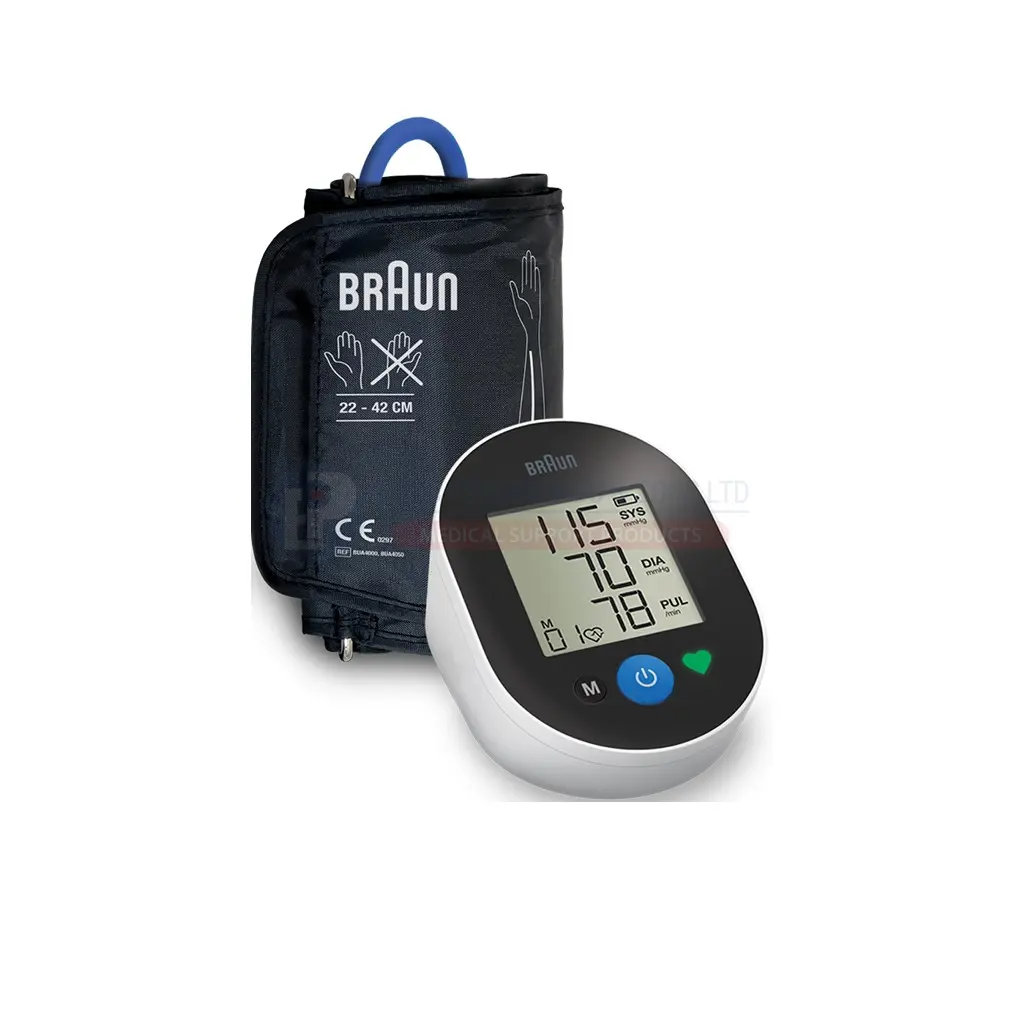
BRAUN EXACTFIT 2 · BUA4050
A clear record.
A straightforward routine.
- 30-reading memory
- Review recent measurements on the device.
- 22–42 cm cuff
- Check your arm measurement before choosing.
- Measures during inflation
- Braun’s soft-inflation design limits tightening to what the measurement needs.
| Model | Useful features |
|---|---|
| ExactFit 1EBUA4000 | Simple one-button operation, 22–42 cm cuff and last-reading recall. Suits a straightforward routine with a separate written or manually entered record. Braun ExactFit 1E specifications |
| ExactFit 2BUA4050 | 22–42 cm cuff, 30-reading memory, colour guide and irregular-heartbeat indicator. Useful when you want recent readings stored on the monitor. Braun ExactFit 2 specifications |
| ExactFit 3BUA6150 | Two cuff sizes, two users with 40 readings each, a backlit display and averaging of the last three readings. A practical option for separate household records. Braun ExactFit 3 specifications |
| ExactFit 5 ConnectBUA6350 | Two cuff sizes, two users with 60 readings each, averaging and Bluetooth transfer to Braun Healthy Heart. Useful if automatic transfer fits your routine. Braun ExactFit 5 Connect specifications |
ExactFit 1E, 2 and 3 are not Bluetooth-connected; their readings can be entered manually in the app. ExactFit 5 Connect supports Bluetooth. Check current phone/app compatibility before purchase. Braun ExactFit 1E specifications · Braun ExactFit 2 specifications · Braun ExactFit 3 specifications · Braun Healthy Heart app FAQs
Frequently asked questions
Does an irregular-heartbeat symbol diagnose a heart condition?
No. It flags an irregularity detected during measurement; movement can also affect the reading. Repeat according to the instructions and seek medical advice if the symbol appears repeatedly. It is not a diagnosis of atrial fibrillation. Braun Healthy Heart app FAQs · Braun ExactFit 5 Connect specifications
Can two people share one monitor?
Check that the cuff fits each person and that the device is appropriate for each user. ExactFit 3 and ExactFit 5 Connect offer separate user memories; select the right profile each time. Braun’s app currently uses one user per app installation, so each user needs their own phone/app profile. Braun ExactFit 3 specifications · Braun ExactFit 5 Connect specifications · Braun Healthy Heart app FAQs
Does the last-three-readings average replace a seven-day record?
No. A device’s last-three average covers those three stored readings. A clinician-requested multi-day record covers a different period and schedule. Keep the full record requested for your appointment. Braun ExactFit 3 specifications · NICE NG136: measurement and home records
YOUR NEXT STEP
Choose the monitor you can use consistently
Check your upper-arm measurement, decide how you want to keep your readings, and explore Braun ExactFit 2. Our team can help with product features and cuff information; your healthcare professional can guide interpretation and treatment.
Sources and further reading
- NHS: high blood pressure
- American Heart Association: home monitoring
- ESH: blood-pressure measurement
- Braun: how to use your monitor
- Braun: what is blood pressure?
- NICE NG136: measurement and home records
- ESH: its role in device validation
- Published BUA4000 validation study
- STRIDE BP: Braun BUA4000
- STRIDE BP: Braun BUA4050
- Cyprus Civil Defence: emergency number 112
Product specifications are linked beside the relevant model. Sources checked on 6 October 2026. UK and US sources support the general guidance; the emergency contact above is for Cyprus. This guide is for general adult home monitoring and does not replace individual medical advice.
High blood pressure often has no noticeable symptoms. A careful home record can give your healthcare professional useful information beyond a single appointment—and a consistent measurement routine makes that record more useful. NHS: high blood pressure · American Heart Association: home monitoring
This guide explains how to prepare, position the cuff and record your readings, then looks at the evidence and practical features behind the Braun monitors available from Prodromou Medical in Cyprus.
Why measure your blood pressure at home?
Feeling well does not reliably tell you whether your blood pressure is high. Over time, untreated high blood pressure can increase the risk of problems including heart attack, stroke and kidney disease. Measuring it is a practical way to identify a concern that may otherwise go unnoticed. NHS: high blood pressure
Home monitoring can help a clinician assess suspected high blood pressure or review how treatment is working. It complements appointments; it does not replace them. Keep taking prescribed medicines unless your healthcare professional tells you to change them. American Heart Association: home monitoring
A reliable routine, step by step
1. Check the monitor and cuff first
Choose a validated upper-arm monitor with a cuff that fits your arm circumference. Measure around your upper arm and compare that measurement with the cuff’s printed range. Take the monitor to an appointment so a healthcare professional can check your technique and compare its readings with their equipment. American Heart Association: home monitoring
2. Prepare before you sit down
Avoid smoking, caffeine and exercise for at least 30 minutes beforehand, and empty your bladder. Choose a quiet room, then rest for at least five minutes before measuring. Make this a repeatable routine at similar times each day. Braun: how to use your monitor · American Heart Association: home monitoring
3. Support your body and arm
Sit on a chair with your back supported, feet flat on the floor and legs uncrossed. Rest your arm on a table or suitable support, with the middle of the cuff at heart level. Keep the arm relaxed; holding it up yourself is not the same as supporting it. ESH: blood-pressure measurement
4. Fit the cuff on bare skin
Follow your monitor’s cuff diagram. Braun’s general guide places the cuff about 2–3 cm above the elbow, snug but comfortable, with the tube unpinched. Avoid a tight rolled-up sleeve. Ask your clinician which arm to use, then use that arm consistently. Braun: how to use your monitor · NICE NG136: measurement and home records
5. Stay still, then repeat
Start the measurement and remain quiet and still. Do not talk, text or watch something distracting. For a standard home record, take two readings at least one minute apart. Braun’s general guide advises about three minutes between readings; follow the interval in your own manual or your clinician’s plan. Braun: how to use your monitor · NICE NG136: measurement and home records
6. Keep both results
Record the date, time, systolic and diastolic readings, and pulse if shown. Save both readings rather than choosing the lower one. If the monitor has separate user memories, check the selected user before starting so records stay distinct.
| Common mistake | A better setup |
|---|---|
| Measuring straight after activity | Allow the preparation interval, then sit quietly before starting. |
| Arm resting too low | Adjust the support so the cuff is at heart level. |
| Cuff over clothing | Place the correctly sized cuff directly on the upper arm. |
| Talking or moving | Keep quiet and still during the reading and the rest between readings. |
| Recording only a preferred result | Keep the complete record for your healthcare professional. |
The preparation and positioning checks above follow ESH’s measurement guidance and Braun’s instructions. ESH: blood-pressure measurement · Braun: how to use your monitor
How often should you measure—and what do the numbers mean?
Agree the schedule with your healthcare professional. When home monitoring is used to help confirm a diagnosis, NICE recommends two readings per session, morning and evening, for at least four days and ideally seven. The first day is excluded when calculating that diagnostic average. Keep every reading so your clinician can interpret the complete record. Ongoing monitoring may use a different schedule. NICE NG136: measurement and home records
- SYS · systolic
- Pressure when the heart contracts and pumps.
- DIA · diastolic
- Pressure between heartbeats.
- mmHg
- The unit used for the blood-pressure values.
The pulse figure is your heart rate, a separate measurement. Braun: what is blood pressure? · Braun ExactFit 2 specifications
A series of readings is more informative than one isolated result. Ask your clinician what range and follow-up plan apply to you. A monitor’s colour indicator is a quick reference, not a diagnosis or a personal treatment target.
What is the evidence behind Braun’s accuracy?
For a blood-pressure monitor, clinical validation is more useful than a broad promise of accuracy. The evidence should identify the exact model, cuff range, population and testing protocol.
A PUBLISHED STUDY · BRAUN BUA4000
Tested against the AAMI/ESH/ISO Universal Standard
A study published online in November 2023 and in the April 2024 issue of Blood Pressure Monitoring found that the Braun BUA4000 met both validation criteria of ISO 81060-2:2018 and its 2020 amendment in the studied general population.
The average device-minus-reference difference was +0.9 mmHg systolic and −0.3 mmHg diastolic, with a standard deviation of 6.4 mmHg for each. These are group results; they do not promise that every personal reading will be within 0.9 mmHg of a reference. Published BUA4000 validation study
ExactFit 1E (BUA4000): STRIDE BP lists this model for adult home use with a validated 22–42 cm upper-arm cuff. ExactFit 2 (BUA4050): STRIDE BP lists it as equivalent to the BUA4000, based on evidence accepted by its Scientific Advisory Board. That is an equivalence listing, rather than a claim that the BUA4050 was the device tested in that particular study. STRIDE BP: Braun BUA4000 · STRIDE BP: Braun BUA4050
What “ESH” means here: the European Society of Hypertension contributes to measurement and validation standards. ESH states that it does not itself validate individual brands or models and directs readers to STRIDE BP. The accurate claim is model-specific validation against a recognised protocol, not a blanket ESH endorsement of every Braun monitor. ESH: its role in device validation
These findings concern the listed models and general adult use. They do not automatically establish suitability in pregnancy, children or particular medical conditions. Ask a healthcare professional to choose an appropriate device where those considerations apply. The BUA4000 study is not presented here as validation evidence for BUA6150 or BUA6350.
Which Braun monitor fits your routine?
Start with cuff fit and the evidence for the exact model. Then choose the recording features you will actually use: simple operation, stored results, separate household profiles or Bluetooth transfer. These four models are listed in our catalogue; follow each product link for current details.
BRAUN EXACTFIT 2 · BUA4050
A clear record.
A straightforward routine.
- 30-reading memory
- Review recent measurements on the device.
- 22–42 cm cuff
- Check your arm measurement before choosing.
- Measures during inflation
- Braun’s soft-inflation design limits tightening to what the measurement needs.
| Model | Useful features |
|---|---|
| ExactFit 1EBUA4000 | Simple one-button operation, 22–42 cm cuff and last-reading recall. Suits a straightforward routine with a separate written or manually entered record. Braun ExactFit 1E specifications |
| ExactFit 2BUA4050 | 22–42 cm cuff, 30-reading memory, colour guide and irregular-heartbeat indicator. Useful when you want recent readings stored on the monitor. Braun ExactFit 2 specifications |
| ExactFit 3BUA6150 | Two cuff sizes, two users with 40 readings each, a backlit display and averaging of the last three readings. A practical option for separate household records. Braun ExactFit 3 specifications |
| ExactFit 5 ConnectBUA6350 | Two cuff sizes, two users with 60 readings each, averaging and Bluetooth transfer to Braun Healthy Heart. Useful if automatic transfer fits your routine. Braun ExactFit 5 Connect specifications |
ExactFit 1E, 2 and 3 are not Bluetooth-connected; their readings can be entered manually in the app. ExactFit 5 Connect supports Bluetooth. Check current phone/app compatibility before purchase. Braun ExactFit 1E specifications · Braun ExactFit 2 specifications · Braun ExactFit 3 specifications · Braun Healthy Heart app FAQs
Frequently asked questions
Does an irregular-heartbeat symbol diagnose a heart condition?
No. It flags an irregularity detected during measurement; movement can also affect the reading. Repeat according to the instructions and seek medical advice if the symbol appears repeatedly. It is not a diagnosis of atrial fibrillation. Braun Healthy Heart app FAQs · Braun ExactFit 5 Connect specifications
Can two people share one monitor?
Check that the cuff fits each person and that the device is appropriate for each user. ExactFit 3 and ExactFit 5 Connect offer separate user memories; select the right profile each time. Braun’s app currently uses one user per app installation, so each user needs their own phone/app profile. Braun ExactFit 3 specifications · Braun ExactFit 5 Connect specifications · Braun Healthy Heart app FAQs
Does the last-three-readings average replace a seven-day record?
No. A device’s last-three average covers those three stored readings. A clinician-requested multi-day record covers a different period and schedule. Keep the full record requested for your appointment. Braun ExactFit 3 specifications · NICE NG136: measurement and home records
YOUR NEXT STEP
Choose the monitor you can use consistently
Check your upper-arm measurement, decide how you want to keep your readings, and explore Braun ExactFit 2. Our team can help with product features and cuff information; your healthcare professional can guide interpretation and treatment.
Sources and further reading
- NHS: high blood pressure
- American Heart Association: home monitoring
- ESH: blood-pressure measurement
- Braun: how to use your monitor
- Braun: what is blood pressure?
- NICE NG136: measurement and home records
- ESH: its role in device validation
- Published BUA4000 validation study
- STRIDE BP: Braun BUA4000
- STRIDE BP: Braun BUA4050
- Cyprus Civil Defence: emergency number 112
Product specifications are linked beside the relevant model. Sources checked on 6 October 2026. UK and US sources support the general guidance; the emergency contact above is for Cyprus. This guide is for general adult home monitoring and does not replace individual medical advice.